Walk into four businesses in your town this month and the marketing will rhyme. Same soft lighting, same slightly too-perfect food, same vaguely European storefront that is not the one you are standing in. This is not because everyone got worse at marketing. It is because the cost of an image went to almost nothing, and everyone reached for the same tool on the same week.
I should say up front that this is not an argument against AI from somebody who does not use it. We use it every day, in this business, on client work. That is exactly why the sameness is obvious to me.
What People Are Actually Reacting To
The complaint online is loud right now, and it is worth reading carefully, because it is not really a complaint about technology.
The thing that sets people off is a generated photo standing in for something real. Someone posted about a local restaurant with AI images of food on its online menu, and the reply underneath it was the whole argument: how bad is your food that you cannot show me a picture of it. Nobody in that thread was objecting to a tool. They were objecting to a substitution.
That distinction matters because it tells you which parts of your marketing are exposed and which are not. Nobody cares if the texture behind your headline was generated. They care a lot if the kitchen in the photo is not your kitchen.
The Moment It Starts Reading as Something to Hide
Here is the uncomfortable part for a service business.
If you fix roofs, install tile, clean carpets or cut hair, the photo of your work is the proof. It is the single piece of evidence a stranger has that you can do the thing. When that photo is generated, you have not just used a cheaper image. You have quietly removed the evidence and replaced it with a picture of evidence.
Most customers will not consciously work that out. What they will feel is that the business looks like every other business, and that there is nothing specific to hold onto. A few will work it out exactly, and those are the ones who tell other people.
The tell is usually not a weird hand or a bent doorframe. It is that the image has no particular place in it. Real work photos have a bad light fixture in the corner, a driveway crack, a house number, a bit of the neighbor's fence. Generated ones are set in nowhere.
Where AI Genuinely Earns Its Place
I want to be even-handed here, because the internet's current mood is not.
There is a lot of small business marketing work where generated output is straightforwardly good and I would not hire anyone who refused to use it:
- First drafts of copy you then rewrite until it sounds like you.
- Layout options to react to, which is much faster than describing what you want.
- Backgrounds, textures, patterns, abstract imagery behind a headline.
- Summarizing a pile of reviews to find what customers keep saying.
- Cleaning up a transcript, writing the boring parts of an email, tidying a spreadsheet.
- Anything internal that a customer never sees.
That is real value on a small budget and it is most of what these tools are actually for. We wrote separately about how the same dynamic plays out in website layout in why AI websites all look the same. This post is about the collateral and the photography, which is a different problem with a different fix.
The Line Worth Drawing
Here is the rule we use, and we put it in writing on our own builds.
Your work gets photographed. Everything else is negotiable.
That is not a slogan, it is a build standard. Earlier this month we set it formally for a fitness equipment client and a supplement brand: their sites use the client's own footage and photography, no generated stand-ins for the product or the work, and on one of them the blog hero images are cut from the client's own photos rather than generated like they are on every other site we run. The reason is not purity. It is that the product is the thing being sold, and a generated version of it is a worse asset even when it is a prettier image.
Apply the same line to a flyer. The job photos are yours. The background, the texture, the icon set, the layout draft, the headline you rewrote: use whatever you want.
What Fifteen Minutes and a Phone Is Worth
The honest objection is that real photos are a hassle, and they are. But the bar is much lower than people think.
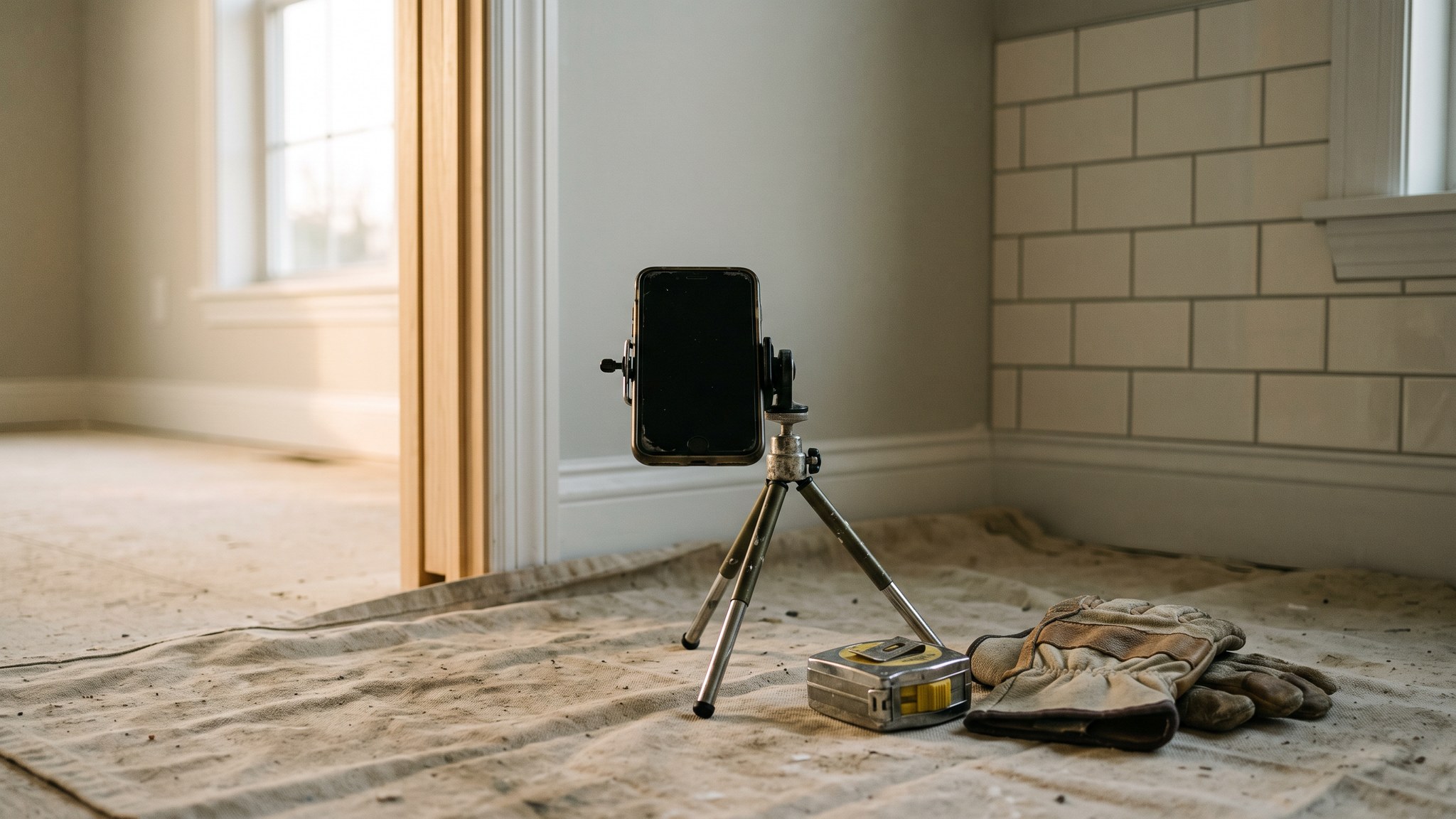
Before you leave a finished job, spend 15 minutes. Shoot in daylight, near a window if you are inside. Hold the phone level. Take 5 times more frames than you think you need, because you will keep 2. Get the detail shots, not just the wide one, because the detail is where the craft shows. A tight shot of a clean cut, a grout line, a finished edge.
It will not look like a magazine. That is the advantage. It looks like a job, in a house, in your town, and nobody else on earth has that photo.
Do that on 20 jobs a year and you have a library no competitor can generate, and it gets more valuable the more common generated images become. That is the part worth sitting with: the scarcity is moving. Not long ago a polished image was the expensive thing. Now a provably real one is.
How to Tell If Your Own Material Has Drifted
Quick audit, and it takes about 10 minutes.
Open your last 10 posts, your current flyer, and your site's homepage. For every image, answer one question: is this claiming to be my work, my team, my premises or my product? If yes, is it actually a photo of that?
Anywhere the answer is no, you have a gap, and it is probably the most important image on the page. Fix those first and leave the rest alone.
If you want a second pair of eyes on what your marketing is currently telling people, that is the kind of thing we do. Our notes on what to look for in a website proposal cover the adjacent question of what you should be getting for the money.