A roofer in Ocean County asked me last month why his website wasn't showing up on Google. He'd paid someone $300 a month for "SEO" for over a year. I pulled up his site. No Google Business Profile linked. No city names on any page. No schema markup. No blog. His title tag said "Home" on every page. He'd been paying for nothing.
That's not unusual. Most contractors I talk to have either been burned by an SEO agency that delivered reports instead of results, or they've done nothing because the whole thing feels like a black box. It's not. Local SEO for service businesses is a finite set of things that either exist on your site or don't. Here's the checklist.
Updated July 2026. Every item below is a lead you own instead of a lead you rent. If you are still buying shared leads from Angi or Thumbtack, the buy leads or build a website math explains why this checklist is the cheaper path per job over time.
One caveat before we get into it: local SEO gets you the visit. Whether the visit turns into a phone call is a different problem — and the one most contractor sites fail. If you're already getting 500-plus sessions a month and the phone still isn't ringing, fix the on-site conversion gaps in why your contractor website isn't getting leads before you pour more traffic into a leaky bucket.
Does Local SEO Still Matter When AI Is Answering Everything?
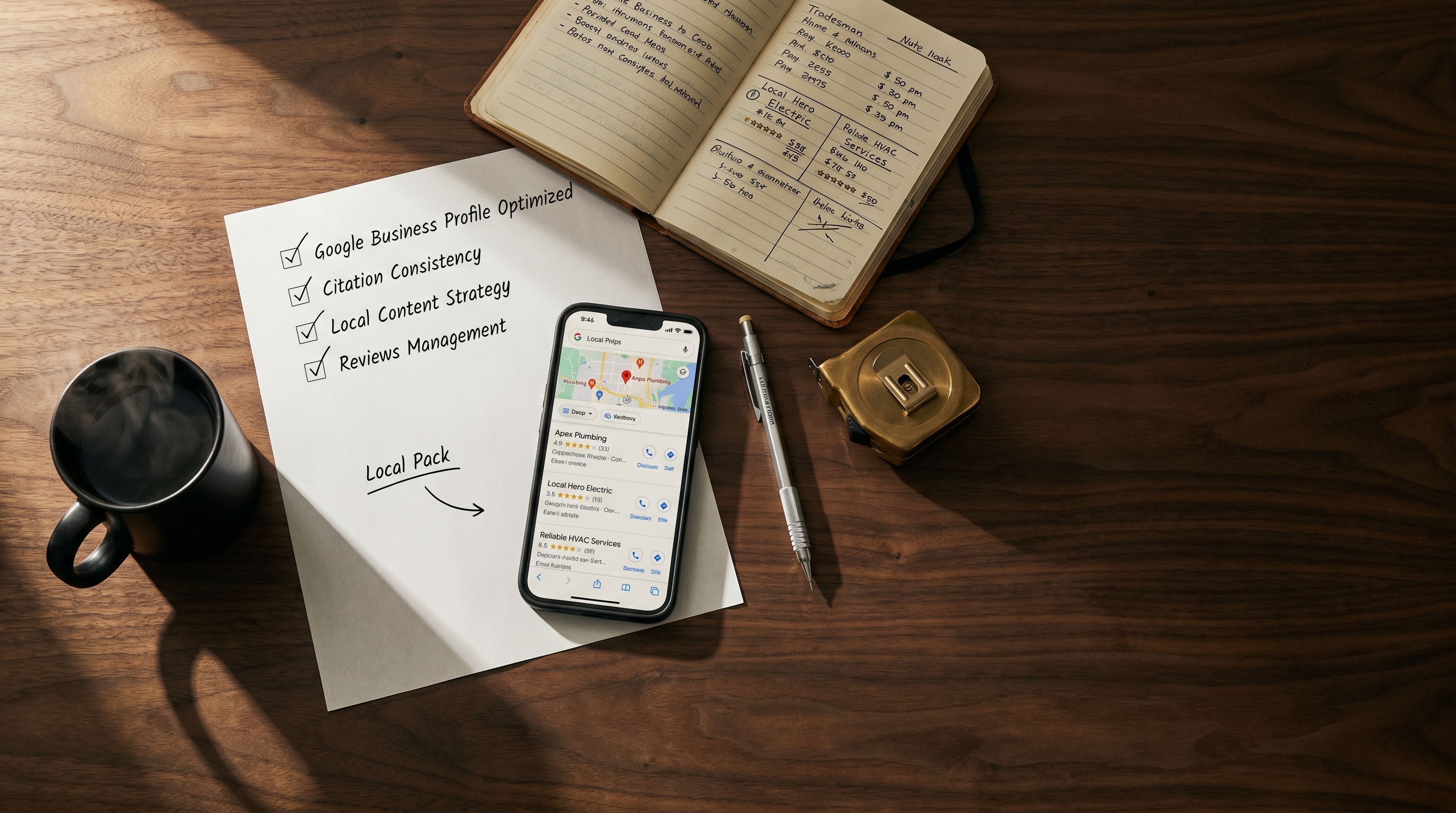
Yes, but the mechanism is shifting. Google's AI Overviews now answer a lot of informational queries directly. "How much does a roof replacement cost" gets answered at the top of the page without a click. But "roofer near me" and "roofing company Toms River NJ" still show the local map pack, and that's where contractors get calls.
The map pack pulls from your Google Business Profile, your website, and your reviews. AI Overviews pull from structured content, authority signals, and citations. You need to feed both systems. The checklist below covers both.
The Checklist
Google Business Profile (GBP)
This is the single most important asset for a local contractor. It controls whether you appear in the map pack, and the map pack is where most local clicks happen.
- Claim and verify your profile if you haven't. Go to business.google.com.
- Primary category matches your main service. "Roofing contractor" not "construction company." Be specific.
- Add every secondary category that applies. Google allows up to 10. Use them.
- Business description uses your target city and service. "Serving Ocean County NJ with residential and commercial roofing since 2005." Not "We are a company that does roofing."
- Service area is set correctly. List the cities and counties you actually serve. Don't set a 100-mile radius hoping to catch everything.
- Photos updated monthly. Job site photos, team photos, before-and-after shots. Google measures photo engagement. Profiles with 100+ photos get 520% more calls than profiles with fewer than 10 (BrightLocal data).
- Posts published weekly. GBP posts expire after 7 days. A weekly update with a project photo and one sentence keeps your profile active.
- Q&A section seeded. Add your own questions and answers. "Do you offer free estimates?" "What areas do you serve?" This content shows up in search and in AI answers.
- Review response on every review, positive or negative, within 48 hours. Google's algorithm factors in response rate and speed.
Website Foundations
Your website needs to tell Google three things: what you do, where you do it, and why someone should pick you. Every page should reinforce at least one of those.
- Unique title tag on every page. Format: "[Service] in [City], [State] | [Business Name]". Every page having the same title is the most common mistake I see.
- Meta description on every page. 120-155 characters. Write it like an ad, not a summary.
- H1 tag on every page matches the topic. One H1 per page. It should include your primary keyword for that page.
- NAP consistency. Your business name, address, and phone number must be identical everywhere: website footer, GBP, Yelp, Facebook, every directory. One inconsistency confuses Google's entity matching.
- Mobile-first design. Over 60% of local searches happen on phones. If your site is hard to use on mobile, Google ranks you lower and visitors leave. Test at pagespeed.web.dev.
- Page speed under 3 seconds on mobile. Compress images, use modern formats (WebP), eliminate render-blocking scripts. Speed is a ranking factor and a conversion factor.
- SSL certificate (https). If your URL still starts with http://, fix this today. It's a direct ranking signal and browsers show warnings on non-secure sites.
Service Pages
Every service you offer needs its own page. Not a bullet point on a "Services" page. A dedicated page with unique content.
- One page per service. Roofing, siding, gutters, windows = four pages, not one.
- Each page has 400+ words of unique content. Describe what the service includes, how your process works, what it costs (ranges are fine), and why your approach is different.
- Include your service area on each page. "We install roofing systems across Ocean County including Toms River, Brick, Jackson, and Lakewood."
- Add FAQ schema to each service page. Three to five real questions with direct answers. Google displays these as rich results and AI Overviews pull from them.
- Internal link service pages to related blog posts and vice versa. This builds topical authority and keeps visitors on your site longer.
Location Pages (The Compound Growth Engine)
This is where most contractors leave the biggest gap. If you serve 20 towns, you need 20 pages. Each one targets "[service] in [town]" and compounds your local relevance over time.
- One page per city you serve, minimum. More granular: one page per service-city combination (e.g., "Roof Replacement in Toms River NJ").
- Each page has unique content. Not the same paragraph with the city name swapped. Google penalizes duplicate content with city-name substitution. Reference local landmarks, climate conditions, building codes, or neighborhood characteristics.
- Include a map or service area reference. Embedding a Google Map or referencing your proximity to local landmarks reinforces geographic relevance.
- Link location pages to your GBP and to service pages. Build a web of internal links that connects services, locations, and blog content.
We build these programmatic SEO pages for our clients and have seen them go from invisible to page-one rankings in 30-60 days for low-competition local terms.
Content and Blog
A blog is not optional for local SEO in 2026. It's how you build topical authority, feed AI search engines, and create internal linking opportunities that strengthen every other page on your site.
- Publish at least twice a month. Consistency matters more than volume. Two quality posts per month compounds faster than one burst of 10 posts followed by silence.
- Target questions your customers actually ask. "How much does a new roof cost in NJ?" "How often should I have my office cleaned?" "What's the best tile for a bathroom remodel?" These are the queries AI Overviews answer, and they pull from pages that answer them directly.
- First sentence after each heading directly answers the question. This is the AEO (Answer Engine Optimization) pattern. AI search engines extract the first sentence after an H2 as the answer.
- Include local references. Mention the cities you serve, reference local climate or building conditions, cite local regulations. "NJ building code requires..." is a stronger local signal than generic national advice.
- Link every post to 2-3 service or location pages. Every blog post should strengthen existing pages through internal links.
Reviews and Reputation
Reviews are a ranking factor for the map pack and a trust factor for conversions. More reviews, higher rating, and consistent fresh reviews all contribute.
- Ask every satisfied customer for a review. The best time is right after project completion, while they're excited about the result.
- Make it easy. Create a direct link to your Google review form and send it via text. Every extra click you add loses 50% of people.
- Respond to every review. Thank positive reviewers by name and reference the project. For negative reviews, respond professionally and take the conversation offline.
- Don't buy or fake reviews. Google's detection is better than ever. One flagged batch can get your entire GBP suspended.
Schema Markup
Schema is structured data that tells search engines exactly what your business is, where it operates, and what it offers. Most contractor websites have zero schema, which means Google is guessing.
- LocalBusiness schema on every page (in the site layout). Include business name, address, phone, hours, service area, and geo coordinates.
- Service schema on each service page.
- FAQ schema on pages with question-and-answer content.
- BlogPosting schema on blog posts.
- Review/AggregateRating schema if you display testimonials on your site.
Test your schema at search.google.com/test/rich-results. If it shows errors or warnings, fix them.
What to Do This Week
Don't try to do everything at once. Here's the priority order:
- Claim and optimize your GBP if it's not already done. This alone can get you into the map pack.
- Fix your title tags and meta descriptions. Every page should have unique ones with your service and location.
- Create one service page per service if you don't already have them.
- Start publishing blog posts that answer customer questions with local context.
- Add schema markup to your site layout and service pages.
- Build location pages for every city you serve.
Steps 1-3 are a weekend project if you know what you're doing. Steps 4-6 are ongoing work that compounds month over month. That compounding is the entire strategy. A contractor who publishes consistently for 6 months will outrank one who spent $10,000 on a fancy site and then never touched it.
If you're going to pay someone else to run this instead of doing it yourself, read how to vet an SEO company before you sign anything first, then what a local SEO retainer actually includes month to month so you know what the monthly fee should cover. The wrong vendor will do steps 1-3 under their own accounts and hand you nothing when you leave.
If you'd rather have someone handle this while you run your business, that's what we do. See how we've built SEO engines for contractors like you or get in touch and we'll walk through what your site needs.