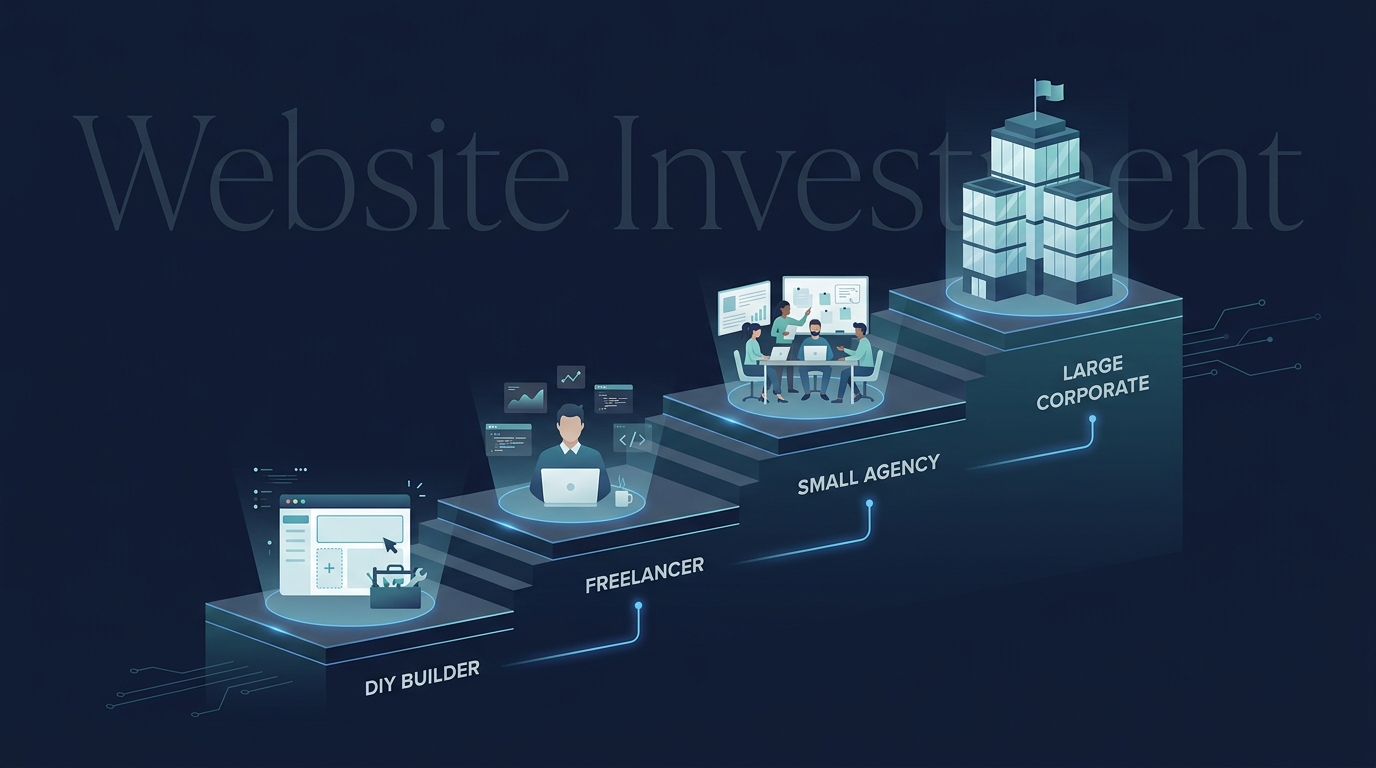
If you've searched "how much does a website cost" recently, you've probably gotten answers ranging from "it's free!" to "$50,000." Both are technically true. Neither is helpful.
The real answer is: it depends on who builds it, how they build it, and what you actually need it to do. Here's an honest breakdown of every option, what it actually costs, and what you get (and give up) at each level.
Option 1: DIY Website Builders — $0 to $50/month
Wix, Squarespace, Weebly, GoDaddy Website Builder. You've seen the ads. Drag-and-drop, no coding required, your site live in a weekend.
What you actually pay: Most quality plans run $16–$49/month. That's $200–$600/year. The "free" plans come with the platform's branding on your site URL, which doesn't look professional.
What you get: A functioning website, fast. Decent templates, built-in hosting, basic SEO tools. Good enough for a side project or a very early-stage business that just needs something online.
What you give up: Every DIY site starts from the same template pool. Your competitor two towns over might have the exact same layout with a different logo. Load speeds are often mediocre because these platforms load a lot of unnecessary code. You're also locked into the platform — migrating to something better later is painful. And if you want something that doesn't fit the template? You're stuck.
Best for: Businesses with minimal budget, minimal complexity, and low stakes if the site doesn't convert. The newer AI website builders fall in this same tier, and they are genuinely good for a brochure page. Before you rely on one to generate leads, though, know what AI website builders leave out — schema, redirects, and the answer content that gets you found.
Option 2: Hiring a Freelancer — $500 to $3,000
A freelancer is an independent designer or developer — usually working alone, often found on Upwork, Fiverr, or through referrals.
What you actually pay: Ranges wildly. A $500 project and a $3,000 project can look the same on paper and produce completely different results. The low end usually means a customized template, light copy edits, and basic setup. The upper end means more custom work, more pages, sometimes light custom functionality.
What you get: More personalization than a DIY builder. A human being to talk to. Usually faster turnaround than an agency.
What you give up: Quality is inconsistent. A great freelancer can produce excellent work; a mediocre one will hand you a slow, generic site and disappear. You often get no ongoing support — if something breaks after launch, you're back on Upwork looking for help. And most solo freelancers don't have the range to handle design, development, SEO strategy, and copywriting all at once.
Best for: Businesses that have clear requirements, a tight budget, and a specific project scope (like a single landing page or a small portfolio site).
Option 3: A Small Agency Like Current Digital — $300–$2,000 upfront + monthly
This is the tier that most growing small businesses land in — and the one we operate in at Current Digital Co.
What you actually pay: Upfront costs vary based on complexity. A simple service business site might run $300–$800 to build. A more complex site with multiple service pages, custom animations, integrated booking, and a blog might be $1,200–$2,000. After launch, there's usually a monthly retainer covering hosting, maintenance, updates, and ongoing improvements — typically $100–$300/month.
What you get: A custom-designed site that's built specifically for your business — not a template with your logo dropped in. Faster load times because the code is clean. A team that handles the whole thing: design, development, copy guidance, SEO setup. And critically, someone to call when something goes wrong.
A good small agency also thinks about your site as a business tool, not just a design project. That means clear calls to action, Google Analytics configured, local SEO foundations in place, and a layout built to actually convert visitors into leads.
What you give up: More upfront investment than a freelancer, though often not as much as people expect. You're not getting a 12-person strategy team or a brand identity system — if you need that, you need a bigger shop.
Best for: Small businesses serious about generating leads online and wanting a site that actually performs. If you're leaning toward this option, start with a clear website brief — it'll help your agency scope the project accurately and avoid surprise costs.
Option 4: Mid-Size and Large Agencies — $5,000 to $25,000+
Full-service digital agencies with dedicated project managers, strategists, designers, developers, QA teams, and account reps.
What you actually pay: Entry-level at established agencies starts around $5,000–$8,000 for a basic site. Complex builds with custom functionality, e-commerce, or heavy integrations run $15,000–$25,000+. Enterprise-level work can go well beyond that.
What you get: A structured process. Dedicated project management. A team with deep specialization in each area. Formal discovery phases, brand strategy, content strategy. Multiple rounds of design revisions. Professional QA.
What you give up: Speed and agility. Agency projects often take 3–6 months from kickoff to launch. You're paying for overhead — offices, account management, layers of process. And at most agencies, your $10,000 project isn't their biggest client, so it doesn't always get the A-team's full attention.
Best for: Companies with bigger budgets, complex requirements, and time to go through a full agency process.
The Honest Truth About Value
The most expensive option isn't always the best fit, and the cheapest option usually costs more in the long run — either in lost customers or in the time you spend fighting with a platform that doesn't do what you need.
The sweet spot for most small businesses is somewhere in Option 3. You get a real custom site built by people who know what they're doing, without the overhead costs of a large agency or the quality risk of a race-to-the-bottom freelance hire.
At Current Digital Co, we work specifically with small businesses who are ready to invest in a site that actually generates leads. We're not the cheapest option, and we're not the most expensive — but we'll be there when the site goes live and the work doesn't stop there.
One thing most pricing guides skip: the cost of what happens after launch. Hosting, maintenance, SEO, content — these are ongoing investments that determine whether your site generates leads or collects dust. We break down the full post-launch picture in our guide on what happens after your website launches.
Once you're comparing agencies, knowing what to look for in a website proposal will save you from the most common traps — vague scopes, missing timelines, and ownership ambiguity.
If you want to know what a site for your business would actually cost, book a free 20-minute call and we'll give you a straight answer.