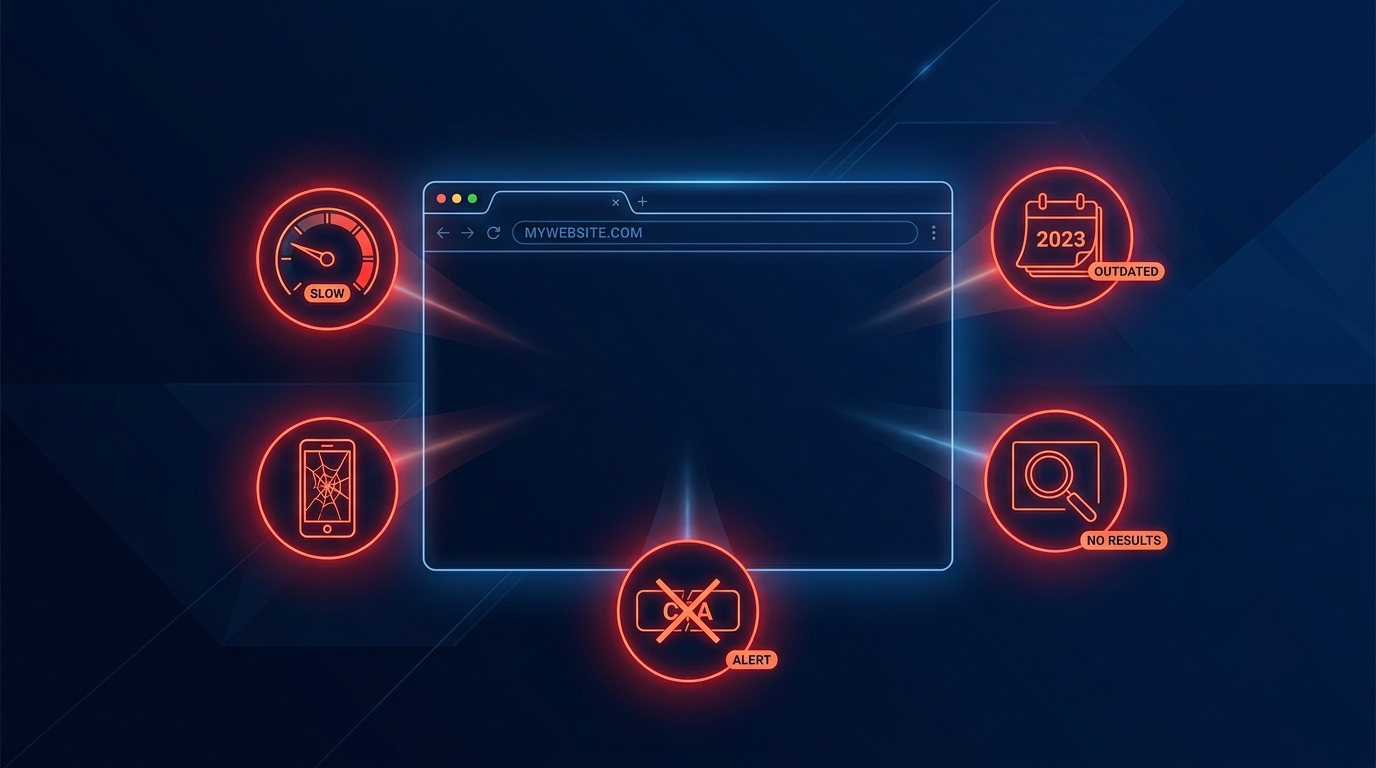
Your website is working right now — while you're sleeping, while you're on a job site, while you're with a customer. The question is: is it working for you or against you?
Most small business owners assume their website is fine. It's up, it loads, it looks okay. But "okay" isn't the bar. The bar is whether it's turning visitors into phone calls and form submissions. And for a lot of small business websites, the answer is quietly: no.
Here are five signs your website is losing you customers — and what to do about each one.
1. It Takes More Than 3 Seconds to Load
You've probably heard this stat before, but it's worth repeating: Google found that 53% of mobile users leave a site that takes longer than 3 seconds to load. Over half. Gone. And they're not calling you from a competitor's page — they're just gone.
This matters even more now that AI Overviews have taken over the top of search results. The users who do click through to a website are already comparing you against an AI-generated answer that loaded instantly. If your site makes them wait, you've already lost the comparison.
What to do: Go to pagespeed.web.dev and run your homepage. Look at your mobile score — that's the one that matters most. Common culprits are oversized images, outdated hosting, and page builder themes loaded with unnecessary plugins. Each one has a fix.
2. It's Not Built for Mobile (And Most of Your Visitors Are on a Phone)
Over 60% of all web traffic now comes from mobile devices. For local service businesses — plumbers, roofers, cleaners, contractors — that number is even higher. People searching "emergency plumber near me" at 8 PM are on their phones.
If your site is hard to navigate on mobile — small text, tiny buttons, contact info buried at the bottom — those visitors are leaving and calling someone else. And since Google uses mobile-first indexing, a poor mobile experience hurts your search rankings too. It's a double penalty.
What to do: Pick up your phone and try to use your own website. Find your phone number. Try to submit a contact form. Try to navigate to a services page. Time yourself. If any of it feels frustrating, your customers feel the same way — they just don't tell you before they leave.
3. There's No Clear Call to Action
A visitor lands on your site. They read a little. They're interested. And then... nothing tells them what to do next.
This is one of the most common and most expensive mistakes on small business websites. The contact info is in the footer. The phone number is tiny in the header. The "Get a Quote" button doesn't exist, or it's buried below the fold where nobody scrolls.
Visitors won't hunt for a way to reach you. They have four other tabs open. If it's not obvious and immediate, they move on.
What to do: Every page on your site should have one clear primary action — a prominent button, a visible phone number, a form. Put it in the header. Put it above the fold on every page. Repeat it in the middle and at the bottom. "Call Today," "Book a Free Estimate," "Get a Quote" — specific beats generic. Test it on your phone before you decide it's obvious.
4. Your Design Looks Like It's From Five Years Ago
Design moves fast. What looked modern in 2020 looks dated in 2026. And while you might not consciously notice an outdated design, your visitors do — they just can't articulate why they don't trust the site.
Research from Stanford's Web Credibility Project found that 75% of users judge a company's credibility based on their website design alone. Before they've read a word. Before they've seen your reviews. The visual design is making the first call on whether you're trustworthy.
An outdated site signals: this business doesn't invest in itself. If they haven't updated their website in years, are they keeping up with their trade? That's not the message you want.
What to do: Look at competitors who are winning business. Look at businesses you admire in other industries. What does your site look like by comparison? If it doesn't pass a gut-check, it probably isn't passing your customers' gut-check either. A redesign doesn't have to mean starting from scratch — sometimes targeted updates to typography, color, and layout are enough.
5. You're Not Showing Up on Google
This one's the quietest killer. Your site might be beautifully designed, fast, and mobile-friendly — but if nobody can find it, none of that matters. If you're not showing up when potential customers search for your service in your area, you're invisible to the people who are ready to buy.
Local SEO for small businesses comes down to a handful of fundamentals: your Google Business Profile being complete and accurate, your website mentioning the services and locations you serve, your site loading fast (see #1), and other local sites linking to yours. Most small business websites fail at least two of these.
What to do: Search for your business the way a customer would — "[your service] in [your city]." Do you show up? If not, start with your Google Business Profile (free, takes an hour to properly fill out). Then look at your website's page titles and meta descriptions — are they generic, or do they mention what you do and where you do it? This is the foundation of local search visibility.
Check Your Site Right Now
Not sure how your site stacks up? Our free Website Grader tool gives you an instant score across load speed, mobile experience, SEO basics, and more — with specific recommendations for each area.
Already have a site that launched but isn't performing? The issue might not be the site itself — it might be what happened (or didn't happen) after launch. Read our guide on what happens after your website launches for the exact post-launch checklist most businesses skip.
And if the traffic dropped right after a rebuild rather than drifting down over time, that is a different problem with a different fix. Start with our diagnosis of what breaks when a website redesign hurts search rankings.
If the score is lower than you'd like, or you'd rather just have someone fix it for you, book a free 20-minute call with our team. We'll take a look at your site and tell you exactly what we'd do to turn it into a customer-generating machine.